When most coaches think about transition offense, they default to familiar concepts like “running lanes” or a “numbered break.” But what happens when the defense is taught to stop those exact patterns?
The solution? A conceptual approach to transition: The 2-Sided Break, the system designed to attack a disorganized defense, creating high-percentage shots in the critical first 6-8 seconds of the possession.
The Problem with “Running Lanes”
The reason traditional breaks fail is that transition defense is designed to:
- Stop the ball.
- Flow to the ball-side.
- Protect the paint.
By running set patterns, you allow the defense to set their anchors. Coach Brent Tipton’s 2-Sided Break is a conceptual system that throws those defensive rules out the window by focusing on creating and leveraging space before a shot is ever taken.
3 Keys to the 2-Sided Philosophy
The foundation of the system is built on three simple, powerful teaching points:
1. Create Space Before Advantage → Advantage Before Shot
The first goal is simply to create great spacing. Leverage that spacing into an advantage and then take the shot. The offensive players dictate the spacing immediately upon securing the rebound or inbound.
2. Move the Transition Defense Twice
The system is designed to shift which side of the court the ball is on, causing defensive disarray. This movement forces what Coach Tipton calls “Off-Balance Defenders” (OBD) and creates opportunities where two offensive players are guarded by one (“Got two defenders”). By forcing the defense to open their hips and change direction, they slow down and create long closeouts, which we attack.
3. The Power of Corner Spacing
The corner is often the last spot defended in transition. By utilizing the proper spacing, the break frequently generates the ultimate scoring opportunity: a wide-open, catch-and-shoot three from the corner via the power of one more pass.
The Personnel & Movement: Know the Terminology
To run the break, our players need to understand a few key terms and their non-negotiable roles (as discussed in this breakdown of the system):
| Term | Player Action | Role & Purpose |
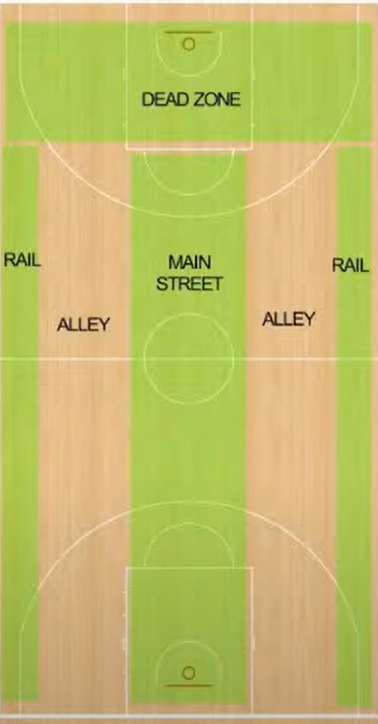
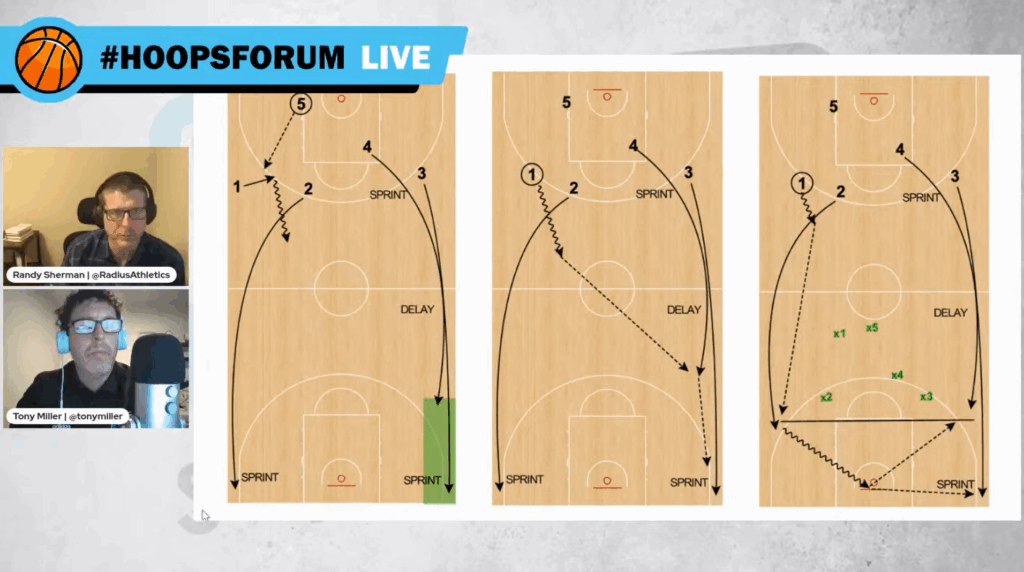
| The Rail | Players 2 & 3 (Wing/Corner Players) | This is the high-speed rail up the sideline. These players sprint with their heads down for the first three steps, flying to the deep corner as fast as they can to create maximum width and depth. |
| Sprint & Delay | Player 4 (The Second Two-Side Player) | This player sprints initially for width and depth, then delays their sprint around half-court. This ensures a good spatial relationship with the first corner player, allowing them to form the crucial 2-Side action. |
| Ball Mover | Player 1 (The Point Guard) | This player is a conduit, not a dribbler. Their first thought is to get the ball ahead via the pass. We want ball speed over dribble speed. |
| The DAP | The Diagonal Advance Pass | The preferred pass is the DAP (Diagonal Advance Pass). Getting the ball across the court immediately forces the defense to open their hips, slow their transition, and start the process of moving the defense twice. |
The “Key-Three-Free” Scoring Goals
The 2-Sided Break simplifies the end goal of transition into three primary objectives, all to be hunted in the first 6-8 seconds:
- KEY: Get an early paint touch (a lay-up or finish at the rim).
- THREE: Find an open, stationary, catch-and-shoot 3-pointer, particularly from the corner.
- FREE: Attack the Off-Balance Defender (OBD) to generate a foul and get to the Free-throw line.
If We Don’t Score: Flow into Early Offense
One of the great features of a conceptual break is that if we don’t get one of the “Key-Three-Free” options, we don’t stop and reset. We flow directly into early offense.
If the defense gets back and we haven’t advanced the ball with a pass (Guard Keep), the big man who is trailing down Main Street is automatically positioned to set a screen. This turns the possession into an immediate Drag Screen (P&R) action, ensuring the defense never gets a full second to breathe or set up their half-court scheme.
Implement the System and Watch the Podcasts and Webclinic
Coach Tipton’s 2-Sided Break is a masterclass in modern, conceptual basketball. It’s a true five-out philosophy that empowers players to make reads and play with freedom while maximizing your team’s scoring potential.
For a deeper dive, watch my full interview with Brent Tipton on “A Quick Timeout.”
Radius Athletics’ Randy Sherman and I broke down the basics of the 2-Sided break on #HoopsForum.